Deforestation Facts for Kids
In 100 Years, there will be no Rainforests…


Time left till the end of rainforests
If current trends continue
There are three main types of forest in the world: Tropical, Temperate, and Boreal. In total, the world’s forests are home to around 3 trillion trees.
From 2001 to 2019, a total of 386 million hectares of forest were lost globally (in all forest types combined). This loss represents an almost 10 % decrease in tree cover since 2000.
One type of tropical forest is the rainforest. Rainforests cover only a small part of the Earth but are home to at least half of all species in the planet.
Sadly, our rainforests are disappearing. And disappearing fast. In 2019, 11.9 million hectares of tropical forest was lost. Primary rainforest made up nearly a third of that loss (3.8 million hectares).
In 100 Years, there will be no Rainforests…
Already in 2000, half of the world’s rainforest had been wiped out. If the rate of deforestation continues, we will have no rainforests left at the end of the century, according to NASA.
When you see paper and wood, what do you think of? Do you think of the tree that was felled to make the product?
Before we started to build cities many centuries ago, they say that 60% of the Earth was covered in Forests. Now, there is less than 10% left.
Deforestation is when forests are converted for other purposes by cutting down the trees to clear the land for other use. With a world population that will reach 10 billion people by 2056, we need more land to build cities, raise livestock and grow food. People also make money by clearing the forests and selling the lumber and wood to be converted into other products, such as paper.
What you need to know about Deforestation
Can you imagine Earth without forests? Here are some deforestation facts for kids that can be shared to raise their awareness about our environment:
- 13 million hectares of forest have been cleared for other uses or by natural disaster. By the year 2030, we might only have 10% of our forests left… and if we don’t stop deforestation, they could all be gone in 100 years.
- Agriculture is the leading cause of deforestation. We clear the land to raise livestock or to plant other crops that can be sold, such as sugar cane and palm oil.
- There are 5 major rainforests:
- a. The Amazon in South America
- b. The Congo in Central Africa
- c. Southeast Asia
- d. New Guinea
- e. Madagascar
More facts:
- Rainforests cover only 6% of the world’s surface… yet they are home to more than 50% of the plant and animal species on Earth.
- A patch of rainforest measuring 4 square miles can contain as many as 1,500 flowering plants, 400 species of birds, 750 species of trees and 150 species of butterflies. Not counting the other living things living there.
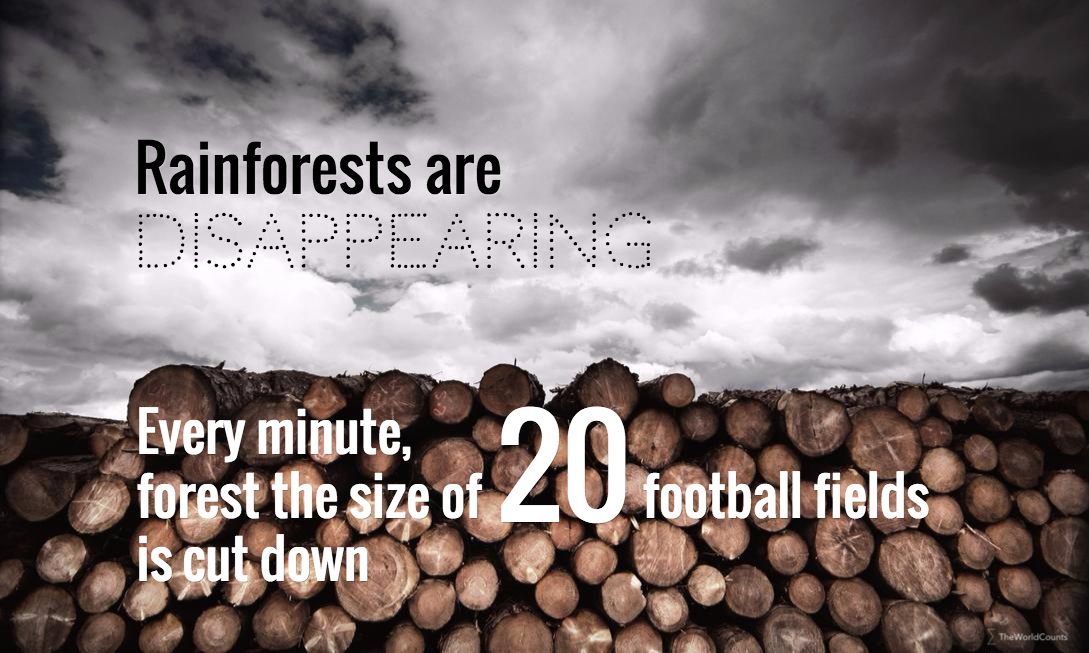
- Every minute, forests the size of 20 football fields are cut down.
Why are Rainforests Important?
Rainforests help regulate the Earth’s temperature and weather patterns. Did you know that 20% of our oxygen is produced in the Amazon? But that’s not all they’re good for:
- They are home to plants and animals. It took 60 to 100 million years for Rainforests to evolve and it is the home of over 30 million species of plants and animals. When we clear the forests, they all die.
- 2) Trees help absorb the harmful carbon dioxide that we humans release in the atmosphere and they provide the oxygen that we need to breathe.
- More than 25% of our medicines today come from rainforest plants. We have only explored 1% of the plants available. Just imagine what diseases the 99% that have not been explored can cure!
- They soak up a lot of rainfall. The rainwater is filtered through the forest floors and supplies water to rivers and irrigation systems. They also help prevent erosion, where the soil is washed away causing blockages that in turn causes floods.
- They are home to indigenous people. Many tribes still live in the rainforests.
If we don’t stop deforestation, more than half of our plant and animal species will be extinct. It is the oldest ecosystem on Earth and they are impossible to replace. It took millions of years for rainforests to develop… how can we replenish fast enough to cope with the rate of deforestation?
What can you do to help save our forests?
There are many ways to help save the forests that are remaining.
- Reduce. Reuse. Recycle. If we recycle the products that come from trees such as paper, then we can use them over and over again. There will be a lower demand for products made from trees.
- Buy from companies that are environment friendly. They don’t ruin our environment just to make money.
- Try to eat less meat which requires grazing lands – another reason why forests are cleared.
- Buy products made out of recycled materials.
- Do not buy newspaper or magazines. Read them online.
- Buy furniture and wood that is Certified. This means that the wood was legally cut down.
Deforestation contributes to climate change
Since trees remove CO2 from the air, the loss of trees also means more CO2. The deforestation from 2001 to 2019 released 105 gigatons of CO2 into the atmosphere - the same as almost two and a half years of total CO2-emissions globally.

Global average temperature rise
Above pre-industrial levels, right now
Time left till the end of rainforests
If current trends continue

Number of Earths humanity currently uses
To sustain our current levels of consumption